Death is a stone you carry in your pocket, turning it over and over waiting for the perfect lake to throw it in. I felt its weight on my naked leg as I woke to the sound of Ghoul meowing above me. His gray cat face peered down into me with acceptance and approval.
I reached up and pet him and he stretched, his warm paws kneading into my naked belly. I was cold, but comfortable. There was a sweetness of the early summer morning ringing through the darkness of the room. I could hear the swans on the ponsdin the distance. As I pet Ghoul, I felt calm, I felt at ease, I felt knowing of where I had to go and what I had to do.
Tabitha was gone from the room and I smelled her in the kitchen before I saw her. I put my clothes back on and I walked out of the bedroom into her living room and kitchen full of ceramics. Ghoul let out another noise, rubbing against my leg, and Tabitha turned, unwavering in her nakedness.
The woman was still naked as she stood over a pan of frying eggs. Her cigarette hanging between her lips. Her white hair nestled gently down her back. On her back, I saw that tattoo of the black-hooded figure and the red nose.
She was beautiful, there in the sunlight, pale like a ghost. I had no sexual feeling for her. I realized, even while we had been with each other, there was something completely unsexual about it. It was revelatory, in every way except lustful, eye opening in every way but titillation. I looked at her now with thankfulness, for her action was for me, not for herself.
When Tabitha turned to me, she looked at me in the same way, no acknowledgement of her nakedness, no declaration of apology, no shame in her body raw and in the kitchen cooking breakfast. She was beautifully true to human death. She was Death, and so was I. Death swallowed up and spat out here in the ceramic filled kitchen in the shadow of the Catskills, peeled of any false pretense of death, beyond the vainness of religion and ceremony, beyond the pity of disease and cancer, beyond the social discomfort of the ending of the story―it’s why I love poetry, and why you might love this book, why Artie might love reading Moby Dick and Coach might love read Ulysses.
The length of the work isn’t what matters, it’s whether the words in the piece can move you, can touch your soul and make it feel life, can make you count the cottonwood seeds snowing in the summer haze while the swans balance on their black pond; can make you watch the shadows shrink and then grow across the faces of the mountains; can make you watch the horses play in the field; can bring you to the rugby pitch with a heart and mind to bleed and die with your teammates; can make you adore the taxis honking on the street, can make the trains rush through the station feel you with anticipation and adventure. It’s in the living, in the moments―the weight of the moments―that bring us away from death not about the longevity, the years added up, but the worth of the words, the word, the breath. What it meant to the reader. Everyone’s a reader, if they read those moments truly. And when they read deeply, they make a fool out of death. They turn death into the clown it is.
“So, last night…” I started to say.
“One night of many, Lazarus.”
“It was a strange night,” I said. “But a good night.”
“It was a passage for you. I hope you could see that.” She pulled the cigarette away from her lips and blew the smoke into the sunlight.
“I saw…that and so much more. I…I think I am ready.” I said these words, certain, somber, certifiable.
“Anything you need to do? Any questions?”
“Well, who are you?” I asked. “Who are you really?”
“Tabitha.”
Ghoul meowed and went on his back in a sun beam.
“Death,” I said.
“Partly. But, that’s everyone.”
“Everyone is Death?”
“No. Death is a part of everyone. So it is with life. It’s like a book, with lots of pages in it, lots of words. Some of the words mean the world to us. Some are completely passe.”
“Or a poem.”
“The really good ones are poems.”
“I love poems. I am a poet, you know.”
Tabitha just stared back at me, arisen, pale, dead, alive. She went over to a kitchen shelf and walked back over to the counter separating her and placed it down.
“I made you something. To make the going a little easier,” she said.
I looked down at the little object that had fit in her palm. It was a ceramic rugby ball that she had clearly made, painted brown in the style of the old school rugby balls.
I looked at it and smiled then put it in my pocket.
“I actually have one more call to make,” I said.
Tabitha hugged me, squeezed me tightly, and held me by the shoulders. Her pale eyes were the rising sun and the rising moon.
I went outside to the rising sun, the mountains yellow in the distance, glowing in their billion year old youth. The sky was that early morning pale blue, the clouds above me were cotton white. But there was a storm in the deep horizon, a black line of a storm over the distant valley. It was climbing northeast, towards us. The grass swayed in a light breeze, and the trees by the pond rattled their leaves in the joyous chiming of summer.
I walked over to the pond where the swans swam gently. In the distance, I smelled honeysuckle and the smell of damp earth. I smelled horseshit too, from the farm beyond the white fence.
I took out my phone and called Tristan.
In a groggy voice, he answered.
“Hey, Laz? Everything okay?”
“Hey, Tristan. It…it is okay. I need you to know something real quick. How…how’s your dad by the way?” I asked, I put my hand to my cheek feeling the swelling. I tickled the loose tooth with my tongue.
“He’s, alright. We got him in last night, but I…I don’t really know, you kind of woke me, so I’m not sure. I bet he’ll be hungover.”
“True. True. Hey, look. You know your mom was a poet, right? You have to know it.”
“We, actually, it’s funny you should say that. We were up all night looking. And then we finally found them. Stayed up late reading them out loud to each other. Some of them are amazing. She was talented, I think. I mean, I don’t know that much about poetry, but Maggie and Daisy are already talking about trying to get them published somewhere for Mom. But, I don;t know if it’d be more for us.”
As he spoke, I put my hand in my pocket and felt the rugby ball, turning it in my pocket, over and over again.
“I think that’s amazing,” I said.
“But…I am not sure,” he yawned, and I heard him moving away from the bed and moving out of his room. “I just feel this…I don’t know, I guess it’s guilt. Like I should have known. I should have done something while she was alive. While she was stuck in this old house smoking cigarettes and hoarding everything she laid her hands on. I feel like…”
“You abandoned her,” I finished for him, squeezing the stone and watching the swans float on the black water.
He was quiet on the other end, and a flash of a memory leapt through my mind; sliding in mud on a rugby pitch and getting hit by a kneecap. And then darkness.
“But you didn’t, Tristan. You supported yourself. You pursued your own dream, you went on to care for people and help people. You didn’t cut her out of your life―”
“I don’t think you know a whole lot about it, Laz, not for nothing. I am not sure if I can really talk about it.”
“Out of the Cradle Endlessly Rocking,” I said.
“What…what did you say?” Tristan said on the other end of the phone.
“Are you outside?” I asked him.
“Yes.”
“Can you see that stormcloud coming up the valley?”
“Yes,” he said again.
And I recited some lines from Whitman’s great poem:
“Shine! shine! shine!
Pour down your warmth, great sun!
While we bask, we two together.
Two together!
Winds blow south, or winds blow north,
Day come white, or night come black,
Home, or rivers and mountains from home,
Singing all time, minding no time,
While we two keep together.”
“Is that…”
“It’s Whitman, Tristan. It’s the poem your mother wrote you about.”
Silence.
“She lived her life. She lived it the way she did. With joy of the mountains, the sunshine. She made a fool out of death. Her poems, her moments of light and silver, of moon glow and John Denver, of animals, the woods, and yes, cigarettes too―she lived a beautiful life. With Elio and Maggie and Daisy, with you. All her grandkids. She lived a life of beauty. Her beauty. And you cannot blame yourself for it. You can’t take it away from her.”
Again I recited to him over the phone:
“My own songs awaked from that hour,
And with them the key, the word up from the waves,
The word of the sweetest song and all songs,
That strong and delicious word which, creeping to my feet,
(Or like some old crone rocking the cradle, swathed in sweet garments, bending aside,)
The sea whisper’d me.”
“That’s the poem…” he said in a soft, broken voice.
“Yes. The poem your mother told you about. That she would tell you her life ws love. Her life was poetry. Uncle Walt Whitman lives beyond death. We all can, for a while, anyway.”
“You spoke to…Mom? You spoke to her?”
“You need to let go of your guilt. Tristan. Don’t take her beauty away from her with that doubting guilt. You need to stop charging into those brick walls, Tristan.”
“That’s…I don’t understand. She’s…she’s okay?”
“Yes. She’s okay. She made a fool out of death.”
“Laz. Thank you for…How did you speak to her? How do you know about the poem? The Whitman poem?”
I almost stammered the words out, “do you see the storm coming up the valley?” I asked him.
“Yes.”
“Well, it’s coming for me, Cap. I think you know why.”
“But…what? Wait… but you’re”
“I am not here forever. I am Lazarus, but only for a short while. Look, Cap…”
“You…you too?”
“I spoke to your mother. That’s how. That’s why I came here. Look, I need to ask you a favor in return…I want you to be my pallbearer. I want you to be my pallbearer, Tristan. I want you to carry my body down below the bedrock. Take my poems as what I leave behind. Tell Anna to read them.”
“You need to tell her.”
“There’s a poem among my things for her. Do this for me. You’ll find them in my hospital room and in my apartment. Tell Anna to help you. To help be my pallbearer.”
I looked over beyond the fences, where the horse farm was. There, in a gap on one of the hills, trotting towards the fence, was a white horse with blue eyes.
“Tell your dad, Tristan, that your mother got her wish. Goodbye, Cap. Tell the boys, we will be playing again soon.” I hung up on him and dropped my phone in the grass.
The storm’s winds began to blow, and the dark cloud was approaching the mountain range. Some light pattering of rain started to fall. It rippled the surface of the pond as the trees swayed and the leaves rattled. That white horse with its blue eyes stared right at me. The swans cackled and then turned in my direction.
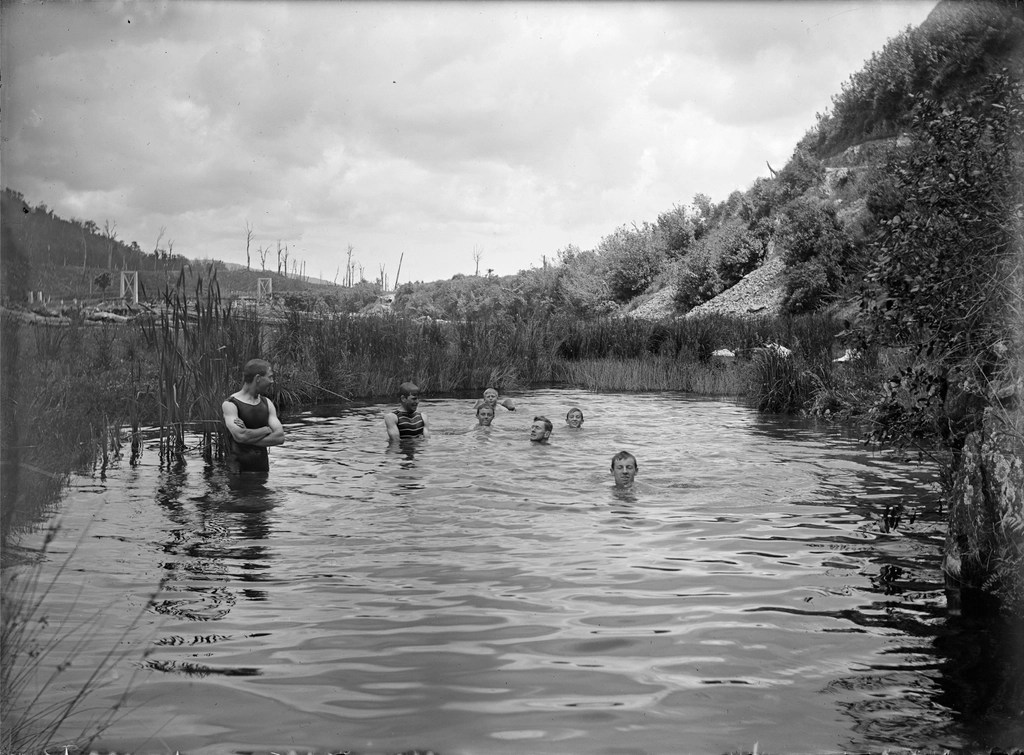
I clutched the ceramic rugby ball in my pocket and kicked off my shoes. I waded into the water. The water felt warm against my cold skin. The rain plummeted down, the storm all around me, thunder and lightning smashing against the sky. The swans swam towards me as the water came waist high. I stepped further into the depths of the pond, falling below the waterline, into the darkness of the water. Deeper. Deeper.
The water was chest high. I took the ball out of my pocket and tossed it as an offering towards the swans. I looked over at the white horse with its blue, blue eyes. Through the rain and the thunder, it seemed to have a red clown nose before it looked away from me and I stepped completely into the water. Into the darkness, the muck and black below…below the bedrock and beyond.
Death is a stone you carry in your pocket, turning it over and over waiting for the perfect lake to throw it in.
 No Poet Peach