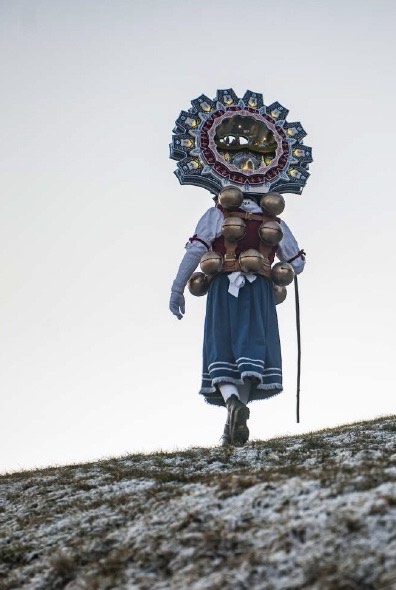
In the high foothills of the Swiss Alps, Death was born from a pool of slush in a streambed. In the frost bitten peaks above the village of Urnâsch, Switzerland, it wriggled like a newborn, but came not with the tolling of whimpers but the tolling of bells. The loud chiming of beautiful bells rang out ever so quietly in the last dark of the old year and in the first light of the oncoming one as Death climbed itself, ever-dry, out of its shallow pool of water and ice.
It wasn’t a black Death from the stories we’ve read about, nor a dark hooded thing, but a walking, joyful looking creature. It was humanoid in nature, dressed in the joyous accouterments of the Appenzell Swiss New Years’ Holiday, Silvesterklausen. That means Death wore the bright blues, the soft whites, the leather boots and the thirteen large softball-sized bells accompanied with every Saint Sylvester on New Year’s Eve. Around its head, as though mimicking the four cardinal directions, were four masked faces carved in four identical ways: the face was midnight black with a pink smile―a flat, soft, patient line sliced by the butchery of deities above―bordered by rosy red cheeks with vacant blue eyes like the still waters of a flood. The most remarkable thing about this Death rising from the slush of the mountainside was that, above its four faces, its head was crowned by a large gold-painted sun that, as the day proceeded onward, seemed to reflect the fading starlight above.
As Death descended, ringing and clanging from its slush-pool birth, it walked towards the small mountain village of Urnâsch, holding with black-gloved hands a large, silver buisine, or long medieval trumpet, by the mouthpiece, using it like a cane. With each footstep breaking through the white snow, the tolls of the many bells clattered with soft harmonies, arrhythmic patterns that sloshed and tolled with the calm footsteps of Death’s descent.
Silvesterklausen was a holiday to celebrate the New Year, and Death tolled down the mountainside in this new year, just as it does in every newborn’s wailing; in the back of the throat is the knowledge that it too will ring the bells of death one day, just as it is told its name and pays the tolls of life. And here, four-faced Death tolled in its outfit, its bells dancing, as it approached the small village in the yellow light of the new sun―it too rang like a bell― as the light fought back the fierce blue which steeled beyond the jagged tips of the mighty Alps.
Hans Schmidhuber awoke from light sleep, restless in a drunken haze from the evening before. The previous evening, the entire village of Urnâsch had celebrated Silvesterklausen and drank like it was the end of the world. The honor of the privilege had been passed down in the community for almost seven centuries, and it was an honor few avoided the participation of. Dressing in the large-belled costumes of Silvesterklausen was not only a pastime, but a joyous form of foreboding tradition, as the village had decreased in its population, economic stability, and tourist trade of skiing and winter sports ever so strongly as the years had gone on. Some buzzed with word each year that it could truly be the last first sun rise.
Hans never slept well with beer in his belly, a defect few Swiss suffer from, and so as he lay next to Elena, her radiating warmth his only comfort from that night, he watched the yellow sun of the new year, January first, shine its light upon the slushy streets of his home. But with the awakening light, through their small cottage, he heard the slight clanging of bells. These were darker in tone, but jangled frequently in comparison to the traditional clanging of Silvesterklausen the night before. For a short moment, Hans thought that perhaps he had dreamed that Silvesterklausen had already occurred the day before. In his morning grogginess he thought that perhaps the holiday was still before him, not something that had been terminated with too much pilsner the night before.
So he began to stir. His first instinct was to pick up the clanging costume he had shrugged off the evening before, and prepare again for the old holiday. But as he sat up from the bed, as Elena stirred so slightly from his movement, he realized the holiday was in fact over, had in fact joyously passed the day before, December thirty-first. The panic of realization had calmed him, and the confusion of the universe rang in the soft, repeated chiming of those bells that descended down upon his little home.
He stood up and walked out of the bedroom, accidentally kicking his own set of bells, his great great grandfather’s bells, and waking up Elena with a start.
“Hans,” she started with worry, “what the hell? What’s going on?” The weight of sleep was still heavy on her eyes.
“Do you hear the bells?” Hans said, his eyes focused on the windows of the cottage, up into the white mountainside outside, he had hardly noticed how he had just tripped over his own bells. There was something doomful in those distant chimes.
“You asshole, of course I have heard the bells, why the hell do you think I am awake?” Elena said with impatience.
“Shh,” Hans replied, moving away from the bedroom and opening the front door of the cottage, letting the ice of the Swiss winter kiss his skin and every surface in the small home.
“Hans, what are you doing?” Elena called and fled deeper under the cover of blankets.
He watched the figure, slowly but confidently, drive through the mountainous snow of the hillside as it made its way towards the village, towards the rising sun. Hans heard the clanging of the bells as he watched the figure approach the little cottage, this timeless family home of many a Schmidhuber, on the outskirts of the village. Hans saw the glint of the silver trumpet in the person’s hands, saw the four faced mask, saw that giant crown of the sun straddling the person and its intricate masks.
Who was this? Which villager had wandered into the hills in the dark in a Silvesterklausen outfit they had not shown to the community yesterday? What fool would ring their bells on the first light of the new year in a break from this time-honored tradition. The holiday was always for December thirty-first and January thirteenth, not any date in between.
The four headed figure finally broke through the thick snow and began walking on the slushy, snow-plowed streets of Urnâsch. The figure paused, redirected themself, and faced the sun in the east and began to walk directly towards it. The figure passed twenty feet from Hans Schmidhuber’s front door.
As the cold of the year began to swallow his very bones, Hans called out to this stranger, this wanderer of the ice and snow.
“Who are you, friend? Did we miss you yesterday?” a half smile loomed on Hans’ face as shivers yanked at his vertebrae and his cold toes dug into the frost of the street.
The figure slowed its pace and stopped. Hans realized with this that the bells too hushed their clanging. The morning felt infinite and empty. The mask on the side of the head with its vacant blue eyes seemed to peer through the cold onlooker.
There was silence, a soft, awkward laugh. A laugh like warm porridge, a laugh like apple pie, a laugh like hot tea on a winter evening. Hans felt his skin heat up with the vibrations of the stanger’s soft laugh. He felt a smile grow on his own frigid face and he watched as the figure continued onward, the bells restarting their clanging as this four-headed stranger, as Death with the crown of the sun, walked onward towards the rising first light of the new year.
Hans turned and watched the figure walk away.
“What a drunken fool,” he said in a present tone trying to convince himself that the figure was nothing more than a drunken fool, some liquored harlequin playing a mockery upon the whole ancient tradition. But as Hans forced his chilly self back under the covers and snuggled next to an angry yet fading Elena, he knew that it was something else, something other than a drunken fool. Something from the deep bowels of the known yet unknown.
It was that same feeling he had as a little boy when he stood in a barber shop between two mirrors which faced each other. How he stared at himself infinitely repeating in both directions for seemingly hundreds of miles and how, for a sharp moment, he thought maybe the eightieth version of him in the distance did not move as he moved, did not smile as he smiled, and stood still as he danced with himself and infinity. There was something out of place, wrong here.
Hans Schmidhuber stayed awake in his bed for the next few hours as the sun grew over the mountain village, as life dawned in the new dawn. He was certain that even in the winter silence, beneath the warmth of the covers, that he could hear the distant clanging of those bells. He tried to engrave this memory, this first morning, into his memory; to etch the calmness, the warmth, the comfort of Elena into permanence as he knew something in the world would never be the same.
How that aching feeling had all to do with the ringing of bells and the four-faced slim smiles on those black-headed masks.
“Happy New Year,” he said softly to the white ceiling.
Elena climbed over her chest and kissed him on the cheek, sleep still in her eyes.
 No Poet Peach