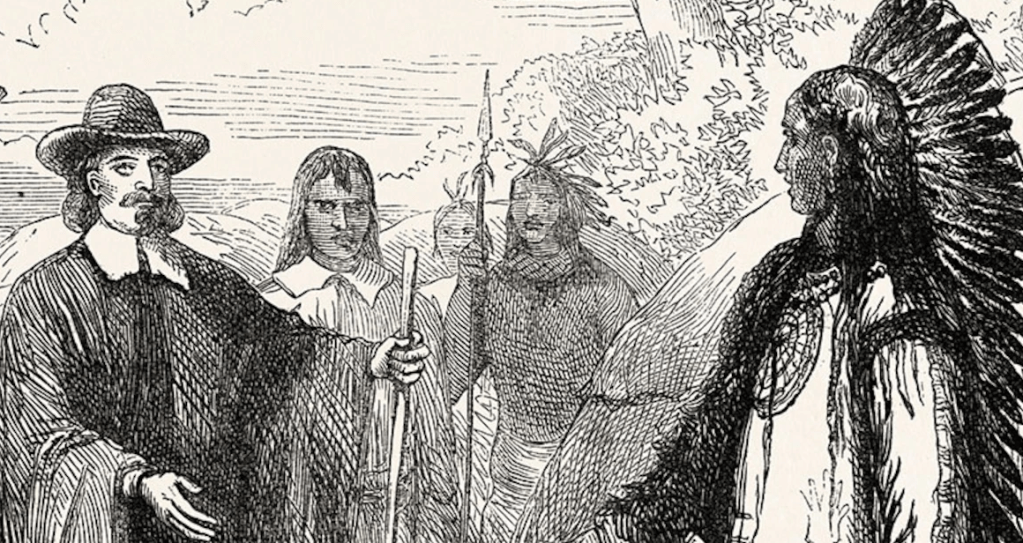
An Excerpt from Delighted & Delirious, my first novel. 2020
Here in the Albany cold, the wind blows wicked across the valley, as the kissing of the Mohawk and the Hudson splash anciently, solemnly in the unrelenting chill. Birds huddle and shiver, their hollow bones fevered with reluctance to leave their ancient homeland, though their feathers are bright and beautiful and swift. The sun glares down through the clouded sky; its great effort is useless against the thick haunch of winter’s licking.
Here, many, many years ago, the little Dutch fort of Beverwijck sprawled out like a scar on the riverside. The bright innards of wood stood flayed and displayed in a walled pantheon as the few Dutch whites of the land stood atop their rude little shelter. They gazed out across the barren trees. Crooked, naked limbs of stark strength creaked and crooned in the blazing winds, and mothers clung needfully to their children, as the children tugged longingly at their skirts.
The little boys would grow to kill turkey and lust secretly after native girls, and pummel the natural order of the land with stubborn European anger. Pink, calloused fists would hammer and slam against the foreverness of the untouched land in an attempt to acquire it, collect it, and name it. For it was their blessing, their safe destiny within the flayed branches of their walls, to do and be God’s doing and being. Within their little fortress, truly, in the palms of their pale hands and in the curls of their blonde hair, was the fiber of God. They knew it, they owned it, they felt it. They were it. It was in their very being that God lived and thrived.
Out there, beyond the walls, was the nothingness. Silent and empty. It waited to be prodded and jolted to life. To the Dutch, their meager little huts beamed as a city upon a hill, no Catskill nor distant Adirondack mountain could compare with the mightiness of the “what will be,” the “what shall be,” which lived in the marrow of each New Netherlander’s heart.
Here in Beverwijck was God, mighty and seated in the hearts of each light-skinned man and woman. The devil lay North. The devil lay South, lay East, and lay West. The unknown was the dark devil, the protestant satan, lurking between the trees and in the shadow of the Indian, in the black mirk of the rivers. There, in the vastness of the unknown, Lucifer laid.
And outside this little wooden drop on a poorly drawn map, the ancient strength of the Mohawk and the Mohican and the Oneida stood. Colossuses which loomed over the eternal world. Human yes, but more than that they were, and are still. Like wizards born from earth and clay, they were masters of the wood and sun and stars above. They were keepers of the land, shepherds of the realm unknown to the white man. Ancient kings and queens of eternal darkness, yet to see in this gathered dark, is to possess true light, true sight, true brightness within and without.
And the colossal natives watched, in the flickering shadow of November trees, in the crisp crunching of the fallen leaves, they watched these awkward rough-tongued Dutch. They watched as these strange white devils flayed the trees, and smoldered the branches, and killed wild beaver, and slaughtered the deer, and dehorned the stag. They listened as these muttering aliens clanged with metal, and blasted bursts of devilry from fire-sticks which boomed across the land.
And the ancient kings and queens of the unmeddled land knew that these white beings were the devil itself, arisen from the womb of the Hudson, their Mahicantuck. Here were the devils in the unknown scar of Beverwijck. A fester in the green skin of the land. They were a termite in the ancient roots of the earthen God. The Dutch, the first great axe to the bark of eternity. For these ancients, the devil had begun to crash down upon them, all at Beverwijck. The unknown scar of Beverwijck was the real devil lurking between the bleak wooden huts of the Dutch. For the Mohawk, the Mohican, and the Oneida, here in the small unknown of the new stranger, here devilry laid.
Yet in the heart of it all, it is that mixture, like mud it is: that mixture of dry dirt and wet water where truly God is. It is in that mixture of the unknown and the hopeful, in the knowledge and the theory, in the fright and the elation, and in the gray dark and the twilight, where God breathes sharply, calmly—even loudly.
And death would come for many back then, as death still comes for many now, and as death will come for all. And one day back then, the natives and the colonizers attempted to know each other, to acknowledge they knew of each other. They ate a feast.
Today, we call it Thanksgiving, when all the unknowing shall one day become known, and all the known shall one day become unknown, as it did back then in Beverwijck, as it did for the Mohawk, so it shall for you, and me, and her, and him, and them.
It is in Thanksgiving, where God comes truly to life. In the fattening of the belly, in the bloatedness from beer comes the traditions of the old, created for no known discernity. For in Thanksgiving, there is a tradition created from acknowledging the hatred of one, and the fears of another. As natives and colonizers came to break bread, hate―devilry still lived in the pit of their bellies, but they suffocated it in drink and food.
And from the great hate on both sides, came one brief meal of goodwill—which, yes—did return again to disarray and chaos. But it is in that mix up of randomness, in that splashing of known and unknown, and fading hate and growing love, where God can boast a hearty chuckle and be thankful that his creations might momentarily ignore ignorance—be it for one meal—to see that God is within their hatred, their fear, their nothingness.
And really it is the knowing that within us all, it is the nothingness that truly lives. When everything is broken down to nothing, when we know truly that each of us is unknown and meaningless, when we see each other’s eyes sparkle with delight and delirium, only then is true meaning and true love found in each of the empty hearts of humankind.
Thanksgiving is to be empty, and to fill one another to the brim. Here God laughs. Here God lives.
 No Poet Peach